
New Takes on Familiar Topics: How Belarusian Female Artists Present Their Projects From Unusual Angles
The Line | Іnterview, 06.12.2025
Beyond traditional art genres, Belarusian women artists confidently experiment with unconventional techniques, merging visual and textual elements for stronger expression. While some focus on conveying personal emotions, others explore complex political processes. For a new piece in The Line series, we spoke with four Belarusian female artists unafraid to experiment with their art.
SHARE:
Article content:
- "Today, photographic projects go beyond just photography." Sasha Velichko
- "The very meanings that make my heart beat faster." Masha Maroz
- "I'm not interested in thinking about whether or not art should be accessible to everyone." Varvara Sudnik
- "I'm tired of traditional painting and applied arts." Sviatlana Petushkova
"Today, photographic projects go beyond just photography" Sasha Velichko
Sasha Velichko, a multidisciplinary artist from Slonim, centers her practice on research-oriented methods to explore propaganda, post-truth, collective trauma and manipulation. Lacking a traditional art education, Sasha turned to art after receiving a Master's degree in quantum radiophysics, seeking to process her personal experience and express a deep curiosity about the world.
“My technical education taught me to structure information, work with large datasets, and recognize patterns. My projects grow out of ideas first, to which I then find an appropriate form, guided by the concept” — she says.

Sasha Velichko / photo from the artist's personal archive.
Sasha began her first major project, State of Denial, in 2023 and continues to develop it, preparing a book for publication. The project investigates how people navigate a digital space saturated with state propaganda. She collected detention stories from Belarus and transformed them into absurd metaphors: in what is often called Europe’s last dictatorship, people could be arrested for the color of their clothing, a bouquet of flowers, or even for praying. Using these stories, she created installations which she then photographed, with each image representing a specific detention.
In the second part of the project, Sasha focused on government news headlines from the days of the detentions. Twelve such headlines served as prompts for AI models to generate images. Through this, she aims to show how, during moments of crisis, state propaganda seeks to hide its crimes by flooding the public with endless visual and news “noise”. The AI-generated images thus redirect viewers’ attention from the real acts of repression.
“I am in a privileged position — I am free, and I can create projects that inform people about Belarus and the horrific situation there” — she adds.
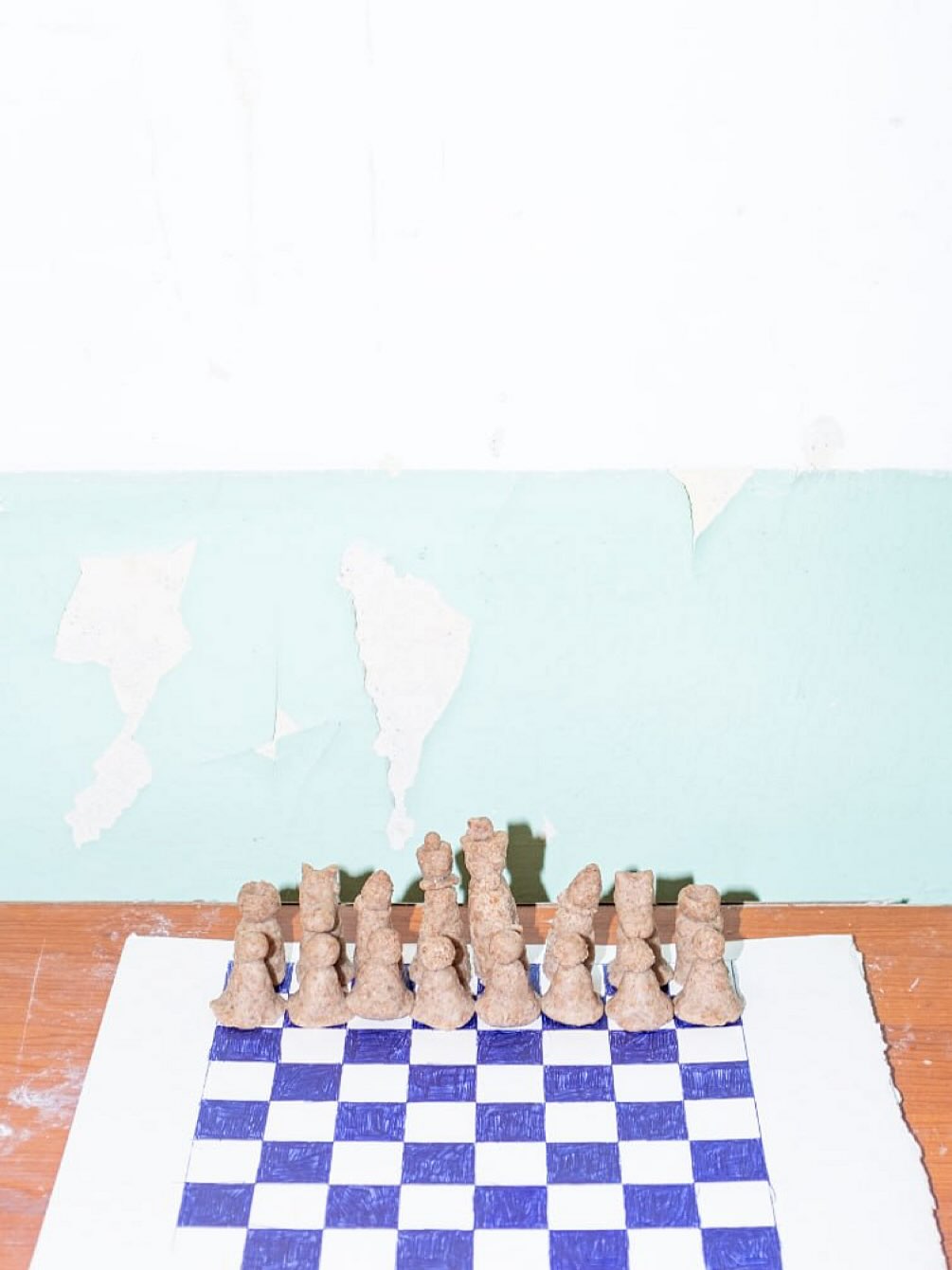

Photos from the State of Denial project / 2025.
Another of her projects, Called to the Carpet, examines mechanisms of biopolitical control. She used mugshots (photos of detainees taken in prison) of female Belarusian political prisoners and created carpets based on them.
The abstracted and simplified images convey the violence of the authorities, who erase individuality and reduce women to mere components of a repressive system. The choice of carpets as a medium is symbolic: weaving has traditionally been women’s work in Belarus, and it also alludes to post-Soviet interiors, where carpets on the walls symbolized protection and stability. Furthermore, female political prisoners in Belarus are forced to work in prisons, especially sewing clothes, usually with little or no training — so Sasha learned to make carpets from scratch herself.

Among her Belarusian peers, Sasha highlights Masha Maroz, whose work is grounded in anthropological research in Polesie; Tatiana Tkachova and her documentary projects; Maryia Karneyenka and Katerina Kouzmitcheva, both active in contemporary photography; and Masha Sviatahor, known for her photographics practices and collages.
“Photographic projects today are no longer confined to photography alone: artists increasingly experiment with programming, archives, 3D-technology, facial recognition and installations, which is endlessly exciting”, Velichko explains.
"The very meanings that make my heart beat faster." Masha Maroz
Masha Maroz represents a cohort of Belarusian women artists who treat tradition not as an aesthetic repository but as a vibrant site of experimentation. Her artistic language emerges from a blend of media, ranging from graphics and installation to fashion, performance, and photography. Archaic and ethnographic motifs lie at the heart of her work — not in a museological sense, but as a source of new narratives.
“Photography is a central element of my practice, especially analog photography. Another essential dimension of my method involves constructing and reactivating narratives drawn from Belarusian tradition and archaic culture,” she remarks.
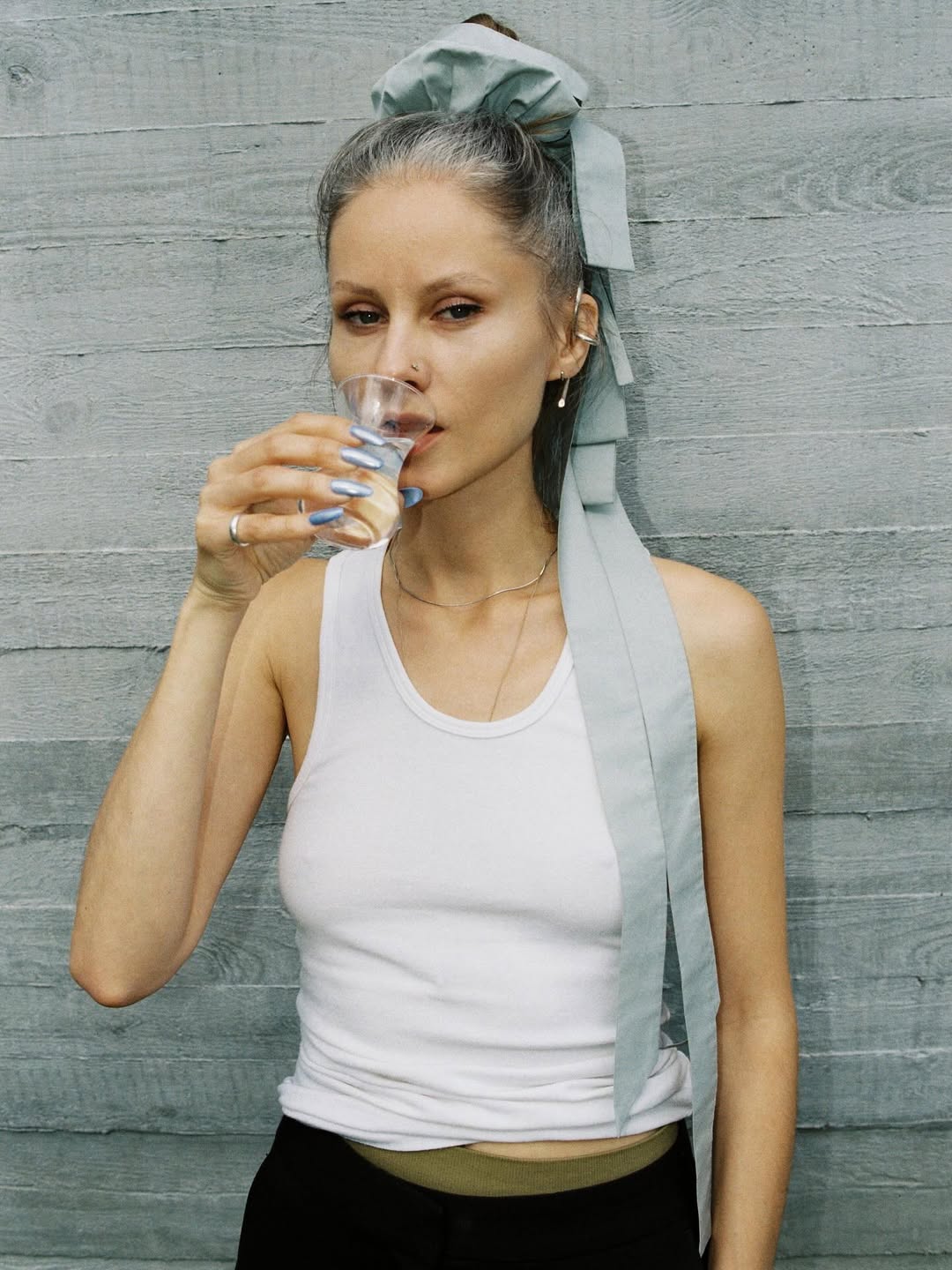
Masha Maroz. Photo from the artist's personal archive
The past year has been a landmark one for the artist, marked by the publication of A Long Way Home, created together with curator Anna Karpenka, philosopher Ihar Babkou, and historian Valer Maroz. The book is devoted to the region of Polesie and synthesizes a decade-long ethnosemiotic study of the area.
“Together we tried to view Polesie as a multidimensional space and to reflect on both its visible and invisible worlds. This book contains the very meanings that make my heart beat faster and guide me through life’', the artist says.
For her it is more than a book project: it continues her research and integrates personal experience into a broader context. Here, tradition functions not as a folk decoration but as a layered space where the seen meets the unseen, and the personal intertwines with the national. A second edition is currently in preparation and will soon be available in Belarusian bookstores.
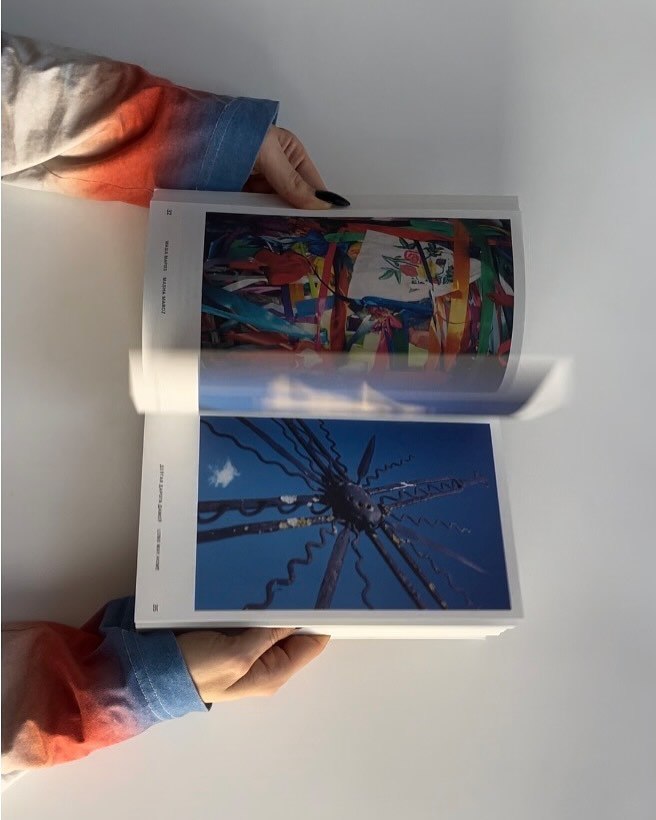
Photo with the book "Long Way Home" by Masha Maroz / from the project page
Maroz’s other major project is “RUN’”, a performance built around a capsule of women’s garments. Drawn from reinterpretations of traditional outfits and sacred objects from Polesie, it examines female experience through the lens of cosmogonic myths: “Both the performance and the collection are inseparably linked with cosmogonic myths that explore how the world came into being and how it is structured. What fascinates me most is that many ethnic groups across continents and languages families share remarkably similar myths”.
The project took five years to complete — from early sketches and sewing to its final presentation. It offers yet another example of how an artist can transform tradition into a language that speaks not only to the Belarusian experience but to universal mythological structures. At its core lies the female body and culture, interwoven into a cosmic history.
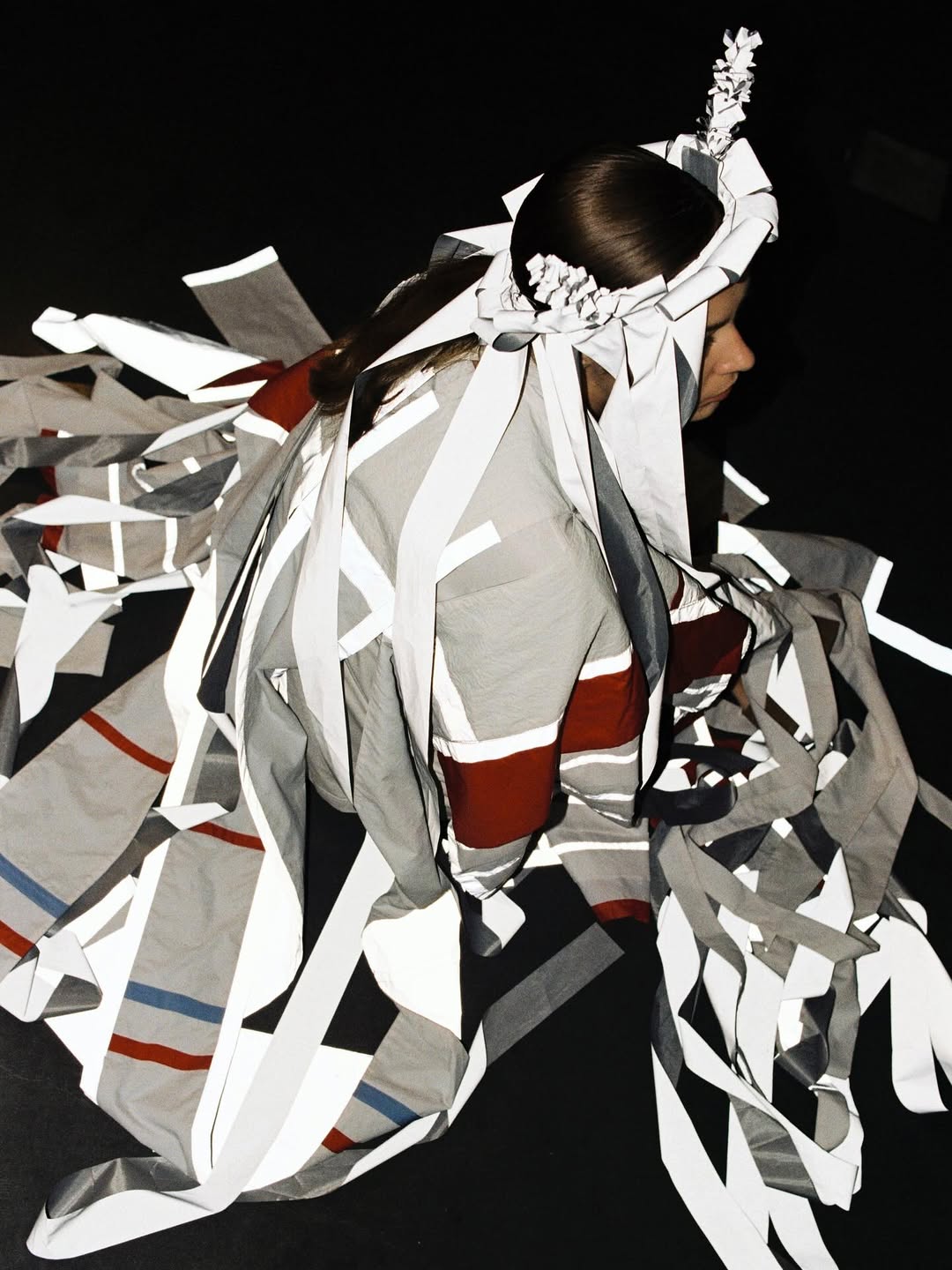
Photo from the presentation of the project "RUN" / 2025.
"I'm not interested in thinking about whether or not art should be accessible to everyone." Varvara Sudnik
Queer artist Varvara Sudnik works across installation, embroidery, and linocut. Her practice engages with themes of alienation, visibility, labor, gender, and trauma.
“It doesn’t interest me whether art should be accessible and understandable to everyone. When I create a project about working conditions, I don’t aim for my colleagues in exploitative jobs to see it. We share this experience together, acknowledging work as a draining place. So if I choose a goal for the project, it is more about carving a small corner within “high art” to speak about what is low and miserable”, she says.
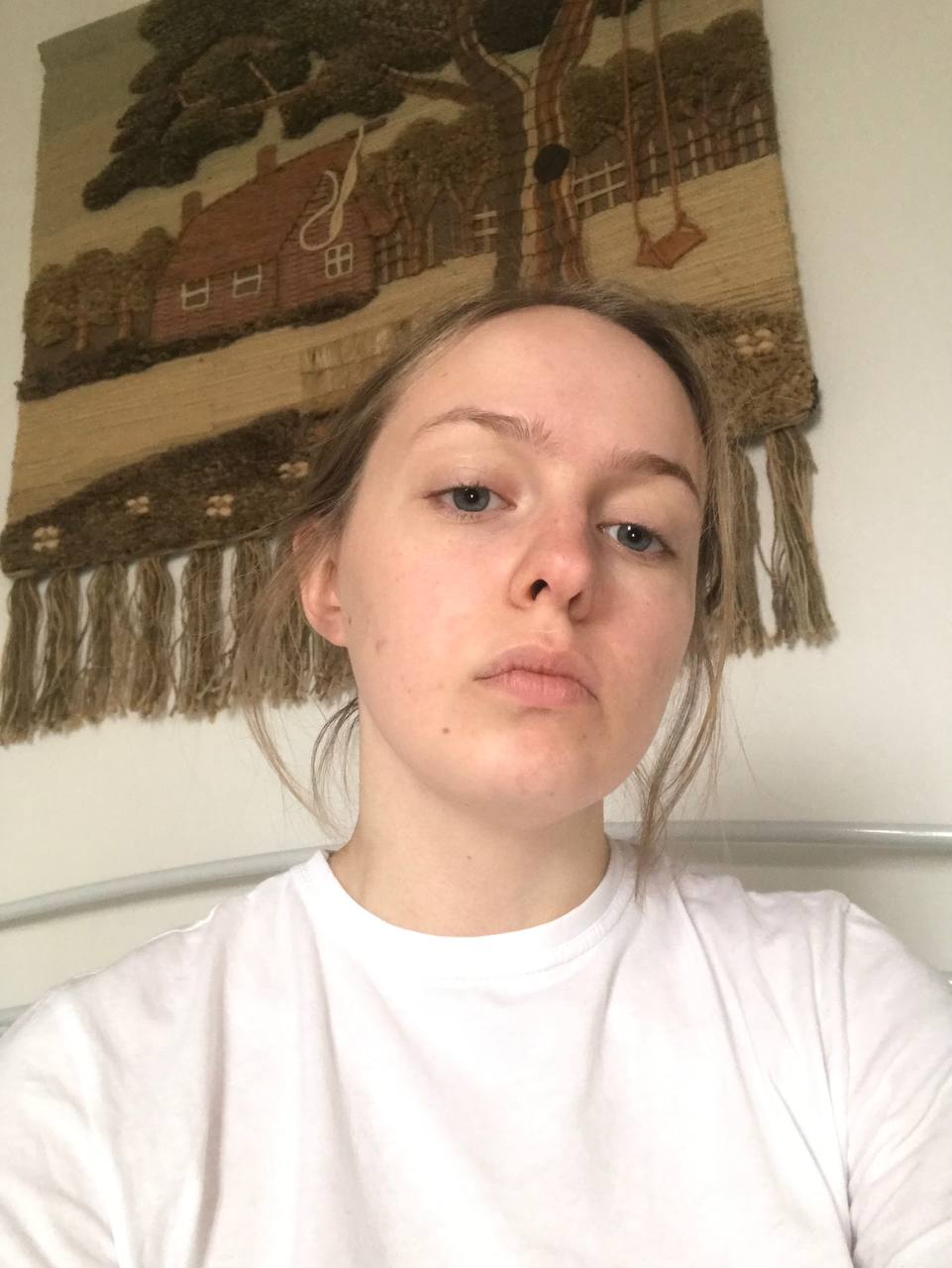
Varvara Sudnik. Photo from secondaryarchive.org
Varvara is currently developing a project centered on cleaning labor and is considering expanding it to address domestic work more generally, including babysitting and delivery work.
“I am interested in the power dynamics between those living in homes and those who work in them, as well as the expectations and pace of labor, job insecurity, and how migration affects these jobs. For a long time I have been collecting diary entries for this project, studying documentary poetry, and now I’m trying to translate this into visual imagery”, she explains.

Varvara Sudnik, The Horned Goat Is Coming, embroidery, 2021. Courtesy of the artist.
Varvara confesses that she often picks new art techniques almost randomly, motivated by the desire to learn something new. Embroidery has been her longest-standing medium, but over the last year she has shifted focus to text, which allows her to express herself more directly.
She closely follows the work of peers exploring different techniques or approaches: “I appreciate the works of Masha Sviatahor, Vasilisa Palyanina, Katsiaryna Miats. My close friend and colleague Vika Grabennikava works with flash-games format (for example, she created a game project about queer marriage). I also want to mention Belarusian women writers who experiment with text in different ways: Nasta Mantsevich, Viktsya Udovina, Hanna Otchyk”.
"I'm tired of traditional painting and applied arts." Sviatlana Petushkova
Sviatlana Petushkova is a well-known Belarusian graphic artist. For her, visual practice today is not just a craft but a space for experimentation and interdisciplinary research. Her artistic practice now emerges at the intersection of different media, though this wasn’t always the case.
“In Minsk, I worked with graphics, but that was far from everything. I was deeply involved in curating and art management, and in 2019 I founded the Belarusian House of Graphics — the only printing workshop in the country open to anyone interested. Besides that, my husband and I organized visual art festivals and created virtual tours of artists’ studios so that people could get to know creators during COVID. In general, in Minsk a lot of my time was taken up by this art management rather than my own work,” Sviatlana explains.

Sviatlana Petushkova. Image from the artist’s personal social media.
Moving to Lithuania became a turning point for the artist. At first, she planned to continue the House of Graphics project there, but she could not find a suitable space and decided to focus on her own artistic practice. Over five years in emigration, she has held several solo exhibitions, become a member of the Lithuanian Artists’ Association, worked in the archive of Lithuanian graphics, created a Gutenberg printing press for the permanent exhibition of the Vilnius Museum of Energy, and completed a master’s program at the Vilnius Academy of Arts.
The master’s program allowed Sviatlana to rethink her understanding of graphic art and Belarusian approaches to contemporary art. “The Belarusian Academy taught seriality and applied techniques, whereas in Lithuania I was taught project-based thinking and conceptual work. Here I realized that graphics is not only printed techniques on paper but a form that can be filled with any material. Sculptures and audio installations can also be graphic art if they leave a trace and are experienced by the viewer,” she notes.
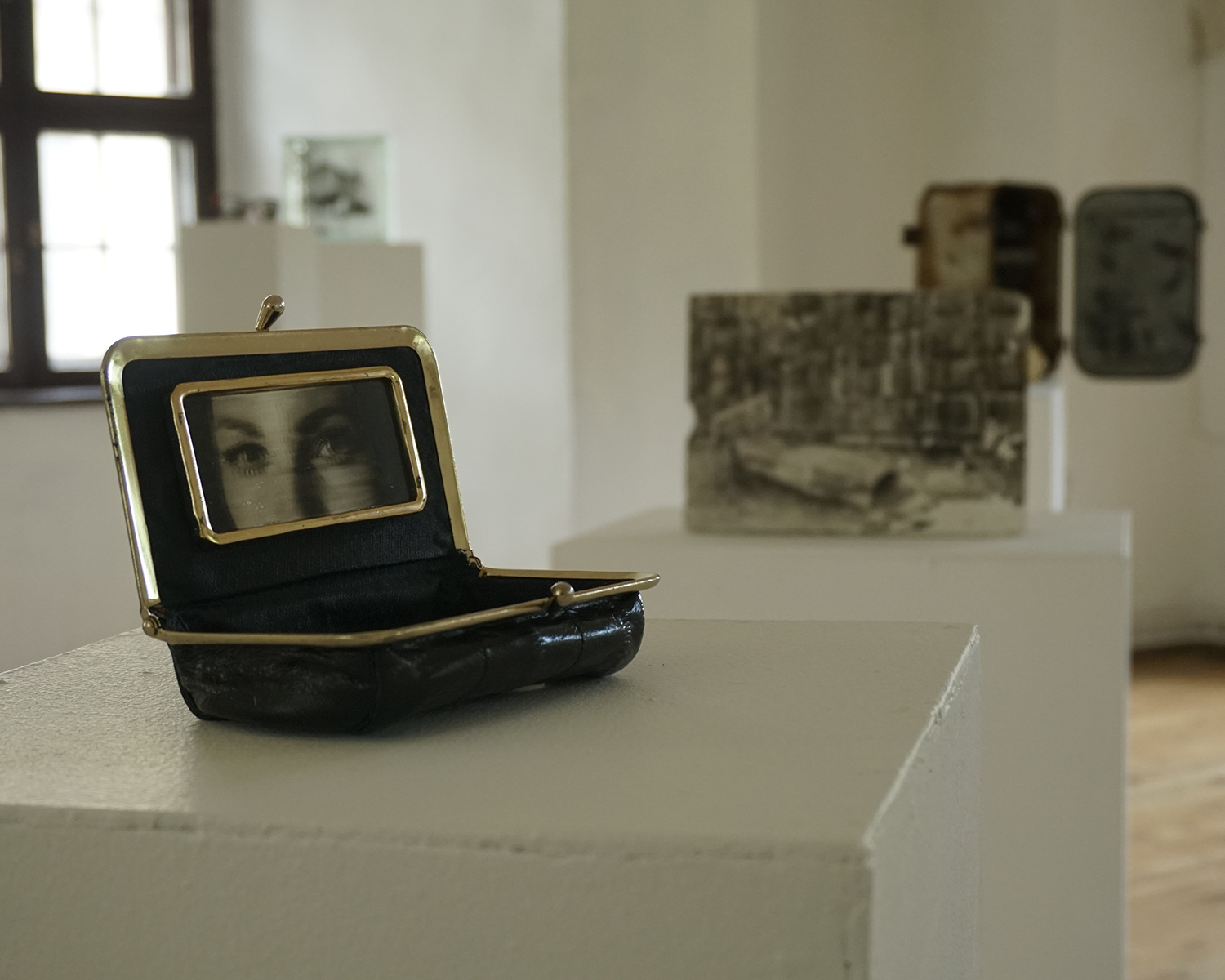
Works from the Artifacts series by Sviatlana Petushkova / photo from the post-semester exhibition at the Vilnius Academy of Arts / 2025.
Today, Petushkova’s projects are more interdisciplinary: “I believe it’s important not to limit yourself with a material or technique. In contemporary art, the idea and the concept come first. You can combine the incompatible, use graphics, sound, video — everything as a tool to express your intention. I grew tired of traditional painting and applied art, which dominate in Belarus. Now I’m inspired by conceptual projects and interdisciplinary research. I love visiting museums and seeing what artists in different countries are doing. It broadens your worldview and inspires you.”
Why, then, is art in Belarus more illustrative and often not grounded in artistic research? According to Sviatlana, the reason may lie in the lack of institutional support.
“When artists work only with their own money, there’s no room to explore new things or engage in contemporary art. There is no institutional support in Belarus, but there are talented people who create what brings income. And for young artists it can be even more difficult when their thesis work at the Academy must be done on approved topics about the homeland, large families, and so on. It simply limits their potential.”
Similar materials


FOLLOW US
INSTAGRAM TELEGRAM TIKTOK FACEBOOK YOUTUBE
© 2026 Chrysalis Mag. All Rights Reserved.
Reprinting of materials or fragments of materials
is allowed only with the written permission