
“I want to see myself as a grain of sand growing through concrete.” Alexei Kuzmich on his book Transit Diary
Interview, 17.12.2025
Vilnius, 2024. Artist Alexei Kuzmich releases Transit Diary. The book looks like travel notes but in fact becomes a philosophical manifesto about life between countries and languages, between the border and freedom, between art and its absence. In this interview for Chrysalis Mag we speak with the art actionist about his first monograph, his view of contemporary art, and plans for Kuzmich’s second novel Imitation.
SHARE:
Transit as an existential space
— You describe transit not only as a geographical condition but as an existential one. Can transit be called a new form of contemporary being?
— Transit is a complex notion. I put into it both my own story of being torn away from the point I previously belonged to, and the global context where people like me have become the majority, if not physically, then at least in a mental crisis. One way or another, transit has penetrated everyone. Paradigms and value pillars crumble within a single generation, and several times over. In one short life a person manages to grow into and be torn alive out of several fundamentally different worldview models. A completely unique situation in the known history of humankind. Time has accelerated to dizziness. A news volcano at every turn. The psyche is in hard decentralization. The body is in permanent shock — out of the well-built postwar society of consumption and comfort it has been thrown into the furnace of radical world transformation: wars, revolutions, dictatorships, exile from home or simple non-belonging to one’s place of birth. Or even to one’s own body, soul, sex. And, in the end, to the human species as such. With all that, we still haven’t received answers to the existential questions humanity has asked throughout its history. That’s how I would characterize what transit means to me.
“Transit” is a game-action started on August 9, 2020 in Minsk as an escape after detention and continued as years-long wandering without documents and legalization. Its rule is not to stay in one place, keeping an unbroken line of the path in order to close it by returning to Minsk. It is Kuzmich’s first work in which he follows the SLAG art system, turning his own existence into a game-based artistic act.
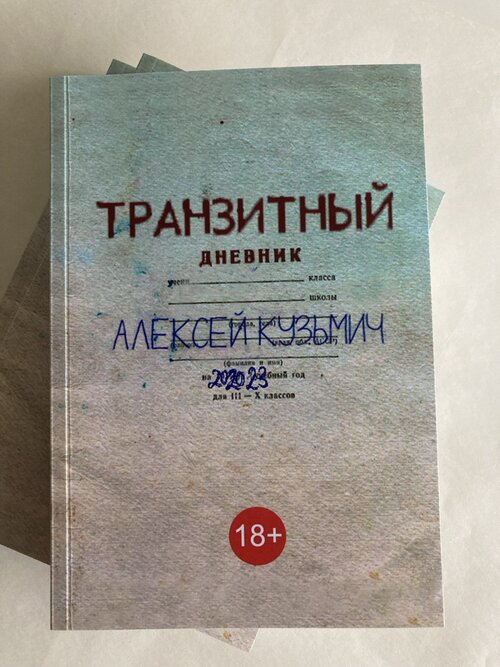
The book "Transit Diary" by the artist-activist and adventurer Alexei Kuzmich (junior) / photo by Logvinov Publishing House / 2024.
— In your notes about borders and airports you fix the space of transit as a metaphor. This state of “neither here nor there” — is it a form of loss or, on the contrary, a form of liberation?
— I’d put it this way: it’s liberation through loss. Turning losses into an advantage. The possibility to shed excess junk — ideological, political, social layers. They may not even be yours; in the end, nothing is really yours — you are a product of the environment, perhaps without a hint of selfness. But there are layers that don’t fit you, that hinder you. Transit allows you to swap them out.
— When you write “the space itself seems to push me further”, is that fate or artistic logic?
— Rather, it’s about feeling space. You step out to the world naked, and it is brutally aggressive, but you need to open yourself to that aggression. The senses sharpen: you begin to interact with it, to hear, to see. All the surrounding space becomes like a single living organism — like some wild extraterrestrial creature. It is both your enemy and your friend, because as it turns out you have no one but it. You both love and hate it, but you coexist anyway. And it answers in kind. The world can erase you in an instant, and you can do nothing to it. All that remains is to listen. Suddenly it turns out the world isn’t such a vicious beast after all. On the contrary, it loves you and endows you with unique opportunities.
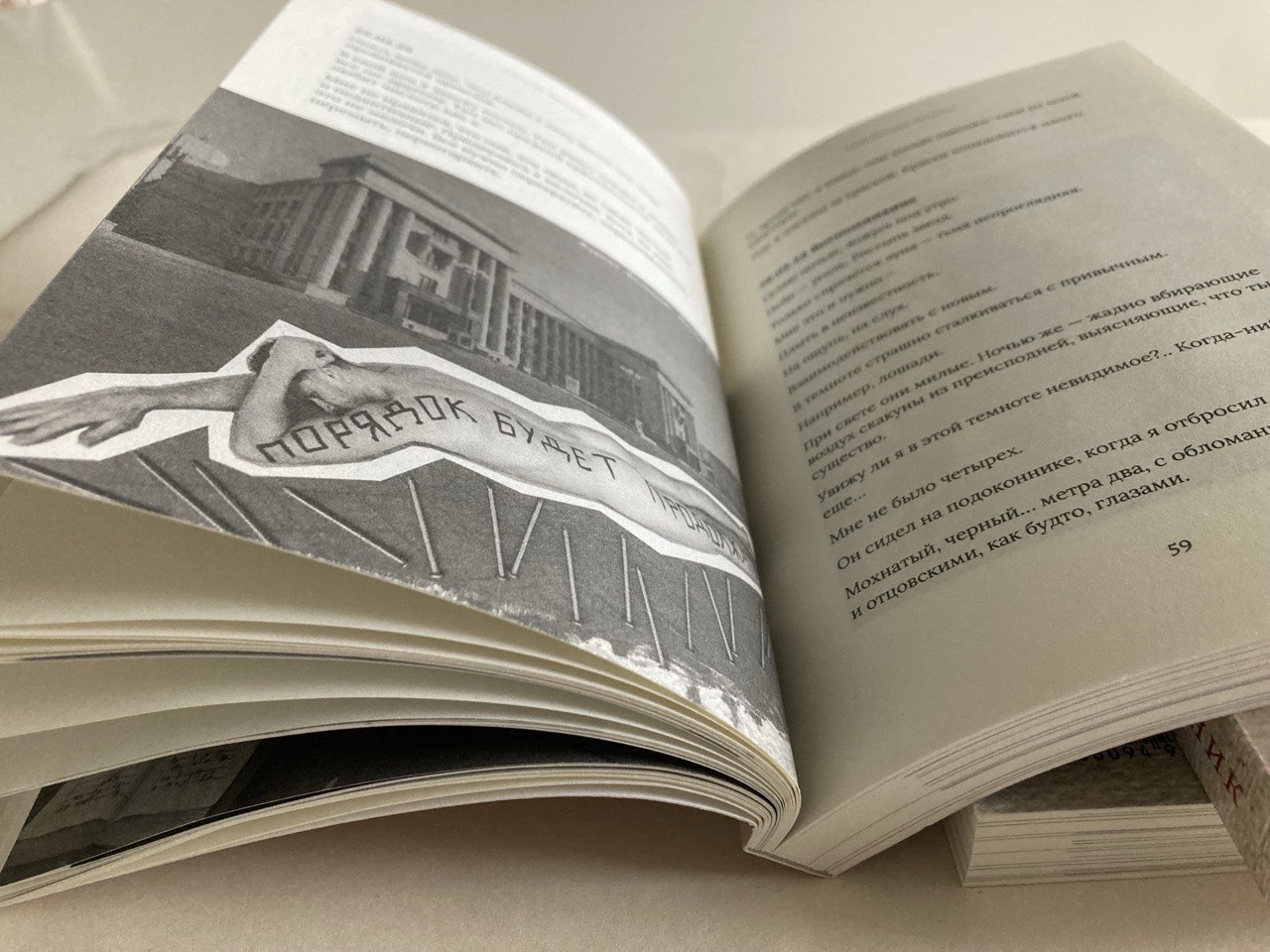
The book "Transit Diary" by the artist-activist and adventurer Alexei Kuzmich (junior) / photo by Logvinov Publishing House / 2024.
The body as archive and instrument
— Your body is an archive of political violence and simultaneously an instrument of art. Can we say that the body in exile becomes the main bearer of memory?
— Like it or not, the body is your diary, with your whole life written in it. A meta-archive from which you can take something, change it, suppress it, or reanimate it. A complicated diary — dangerous, horrific, and beautiful. In any case, for an artist working outside institutions the body becomes one of the main instruments.
— In performance tradition — Abramović, for example — the body was treated as a victim. You use it as irony. Is that a conscious detachment from trauma?
— I don’t work within the trauma plot. Trauma is the foundation of the artistic mainstream and its conjuncture. It’s fashionable and profitable to work with trauma: everyone is traumatized, everyone speaks about their illness, displays their injury, everyone tries to find something like that, if need be sucking it out of a finger. It has become as pop as identity. Everyone demands that their traumatized identities be taken seriously. Everyone declares themselves a victim and of course has nothing to do with violence. Although the aggressive imposition of beliefs about one’s injuries and affiliations can become no less of an aggression for someone else. And voilà — a new trauma.
The word is a sword. In this logic there can be no non-traumatized, no raped, no rapists, no sadists. And all of it is interchangeable and happens simultaneously in one face — the rapist-victim. Human nature as a social being presupposes this. Trauma turns into irony. It’s like a war newsfeed: at first you worry, and then the psyche starts defending itself — you laugh, make memes with corpses and send them to your buddies. The same with trauma: if you stew in it seriously, at the very least you’ll join the happy owners of the “psychotherapist plus antidepressants” booster.
But to accept trauma and use it as material without getting stuck in the sacrificial cauldron — that’s closer to me. Trauma is not a plot but raw material that helps push upward to the next steps. And irony is only one of them.
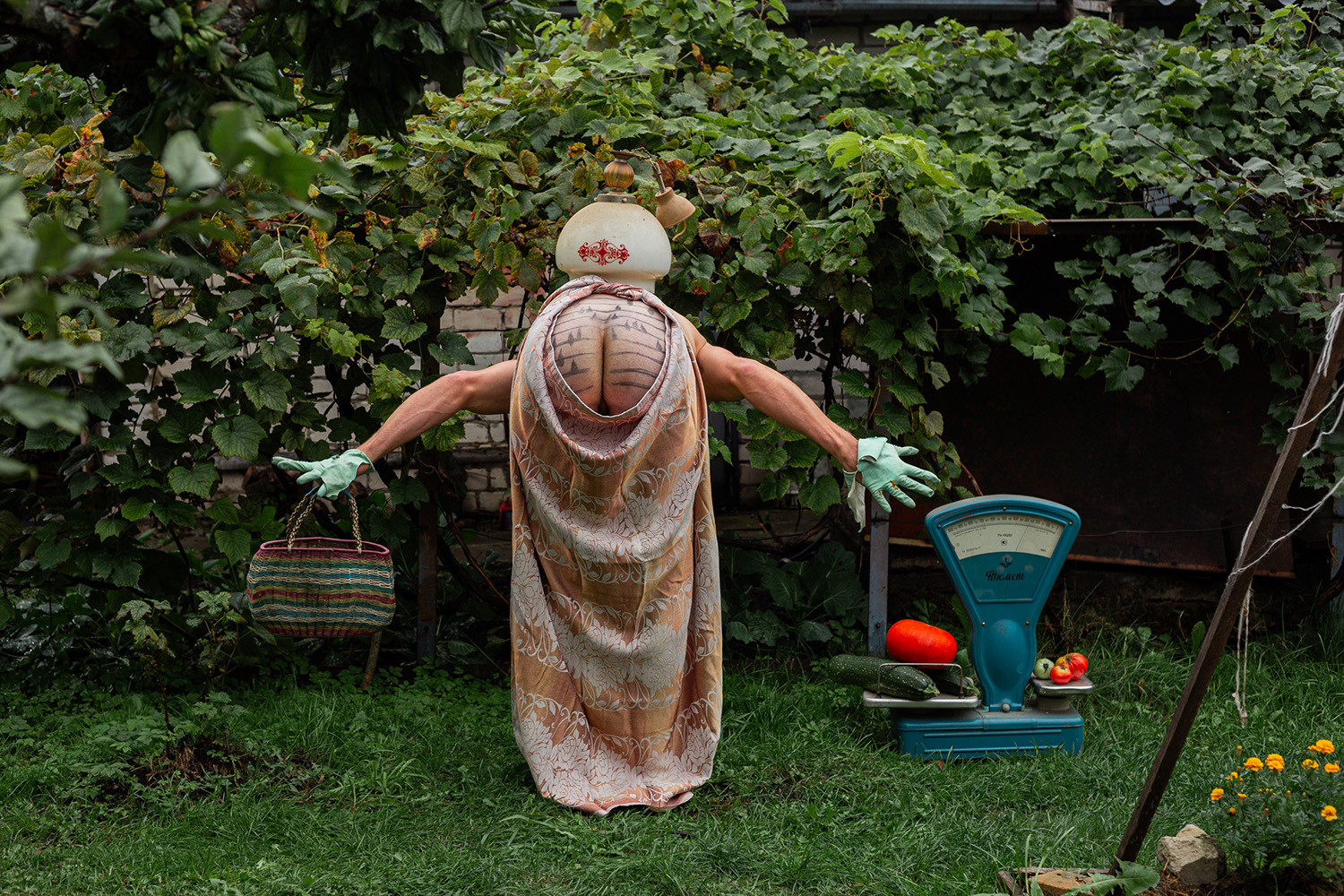
“Transit” / August 9, 2020 – October 9, 2023
— In one fragment you write: “Now I do art while not doing it.” Can the body be a medium of art precisely through the absence of action?
— Easily. Tehching Hsieh made performances by inventing rules and living by them for years. One year he decided not to do art: not to create, not to speak about it, not to write, not to read, and not to touch it at all. His last performance lasted thirteen years, in which he again did nothing and didn’t even reveal its essence. On January 1, 2000, after those years, he wrote the phrase: “I survived.” That was the whole concept — to survive December 31, 1999. After that he quit art altogether. The idea of “doing art by not doing it” already existed and won’t go anywhere. Nothing fundamentally new there.
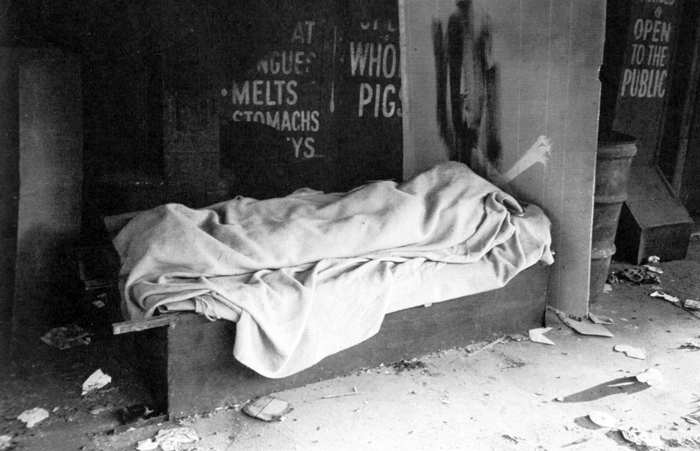
Teiching Hsieh — "Under the Open Sky" / performance / 1981-1982.
As for me, in the context I’ve ended up in, in the environment whose product I risk becoming, it’s important not to do art on command, by necessity — to make as little of it as possible. It’s a way not to end up in the voracious gut of the narrative that now dominates the institutional grant community, without belonging to which being an artist here is almost impossible. You’re required to be permanently active: reporting exhibitions, projects, collaborations, portfolio updates. If you have no new works for three years — you’re sort of no longer an artist, not a professional. In Paris there’s a show in every toilet, in every puked-on or gilded corner of an exhibition, concert, or performance. Dozens of openings every day, where mainly the friends of the next maestro float in for free drinks. All are good artists producing quality art product, by templates. In the end it’s monotonous to indifference. You stop perceiving anything. The formerly sacred and high turns into a garbage dump teeming with parasites and cacophony that litters everything — from back alleys and greasy diners to luxury hotels and historical heritage. And this dump doesn’t even stink, like Manzoni’s little can. Nothing exists except the everyday.
Silence amid this noise is a saving gulp. I think for an artist it’s a must-have — to be in silence more often, to make art as little as possible. Not to litter the world with your artistry, as Marina Abramović once called for in her manifesto (though later she littered the world with it herself). Do something only when there is a radically acute necessity that nothing can hold back.
In short, non-action is also action. A pause is part of the composition, a tuning of sensitivity.
— About the contemporary narrative. In your view, in art does it open doors more or close them?
— The doors are open, it’s easy to get in. But when you enter a white room, every surface has plaques and pointers with instructions: this is allowed, this is forbidden. You receive a guide of rules, and beyond it you can no longer exist. They explain how to be a “good artist,” otherwise you’re simply not considered an artist. Can one create art under such conditions? And will it be art? Let each answer for themselves.
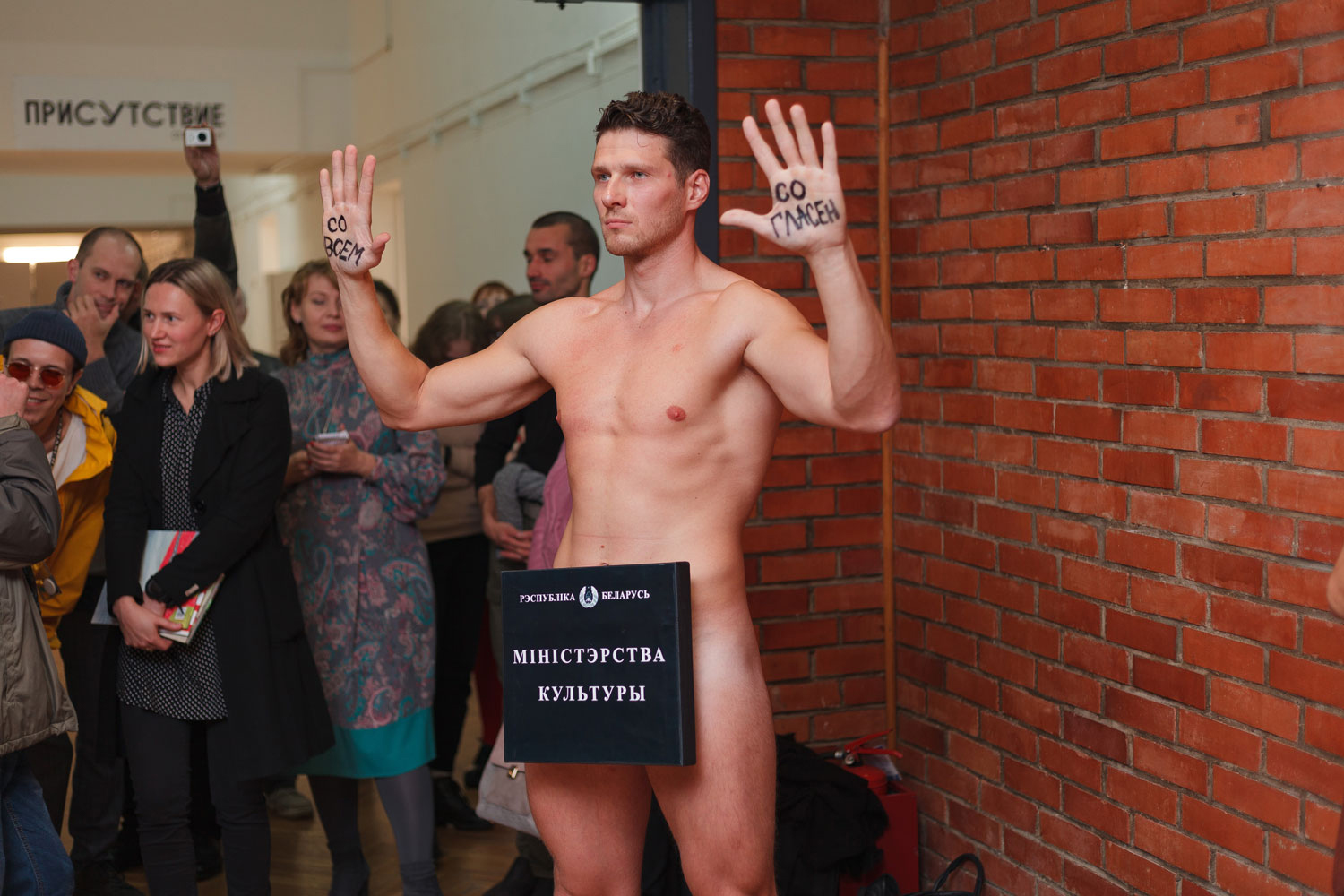
"Shield, or Ministry of Pfaloculture" / 2019, October 3 / Minsk, Belarus
Game and freedom
— You oppose your SLAG art to art with social missions. Isn’t uselessness itself a political gesture?
— Yes, SLAG art can be seen as a political gesture, as opposition. But just as easily one can stretch a social or political context over anything. A child goes to a sandbox — that too can be interpreted as a political act: interaction, rules, structure. Today anything can be called politics. Just as everything is already called art.
I’d call SLAG the fundamental production principle of modernity. The first art that honestly accepts slag as the main product of civilization and recycles its excess into form without utilitarian purpose. The entire cultural narrative, including criticism and deconstruction, becomes now an “object of processing”. Then SLAG equals meta-readymade: an ecosystem for recycling the whole heritage.
We live in a world of piled-up ideologies, fragments of grand narratives, political connotations — from Marxist theories to modern “religions” like the Flying Spaghetti Monster. The brain boils, the body trembles. You can’t continue like this if you want to keep the remnants of physical and moral health. From this huge cauldron of solyanka you have to cook your own author’s little soup in a small beaker. The world is slagged? Recycle it. Produce your own modernity, even if designed for a single taster — yourself.
SLAG art (Self, Live, Action, Game art) — Kuzmich’s authorial art system in which biography, everyday life, and extreme circumstances become artistic material and are structured by principles of game design. It combines art actionism, ritual, and scandal; explores taboos, cyclicity, death, and rebirth, turning the artist’s life into a continuous work without utilitarian goal.
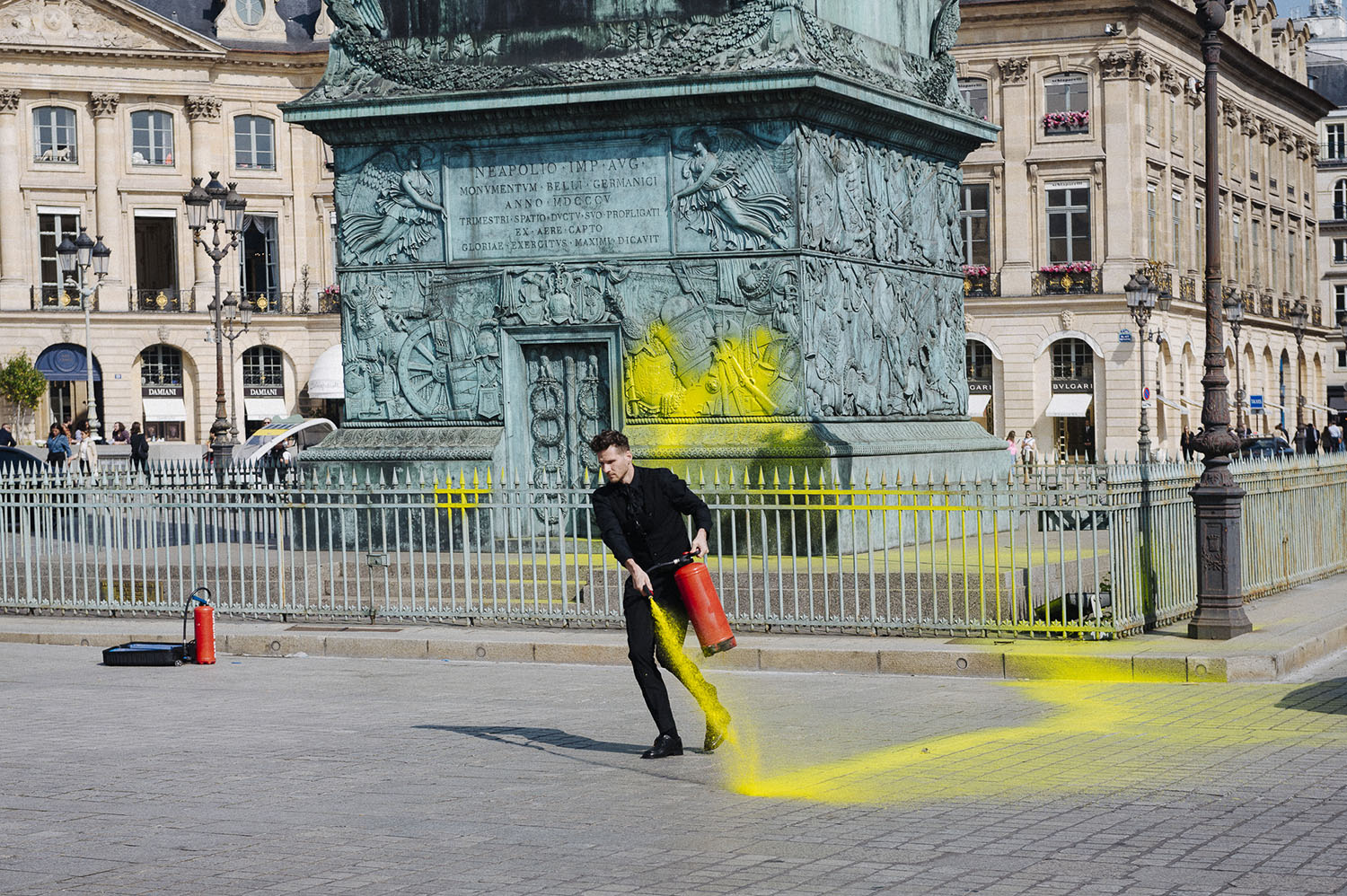
“Insemination” / 2024, September 20 / Place Vendôme, Paris, France
— If art has become a hostage of usefulness, what can return autonomy to it?
— Art became a hostage of usefulness long ago. Autonomy will be returned by freedom — the answer seems obvious. But what is freedom? For me freedom is refusal of involvement (from which today it’s almost impossible to abstain). The contemporary person is wildly atomized, lonely — a zombie of big cities. Rubbing shoulders in dense crowds of their kind, yet isolated and unhappy. Their face is constantly lit by a screen, chat groups are scrolled through feverishly, there’s infatuation with bots, and faith in AI. Intelligence is their best interlocutor — responsive, insightful, licking — albeit artificial.
So yes, we’re stuck. What to oppose? Globally — I don’t know. In my case I oppose the system with my own game, using the system itself. For example, via interventions. I enter the territories of systems that make me gag. In 2019 — the National Center for Contemporary Arts of Belarus, the Ministry of Culture, a planted exhibition, a naked body, viagra, porn, and a ministry plaque on a smoking dick when they called me to the mic to deliver a ceremonial speech at the opening. Or 2020 — I cast my vote at the polling station, crucifixion, stigmata, a red phallus over the ballot with the list of presidential candidates.
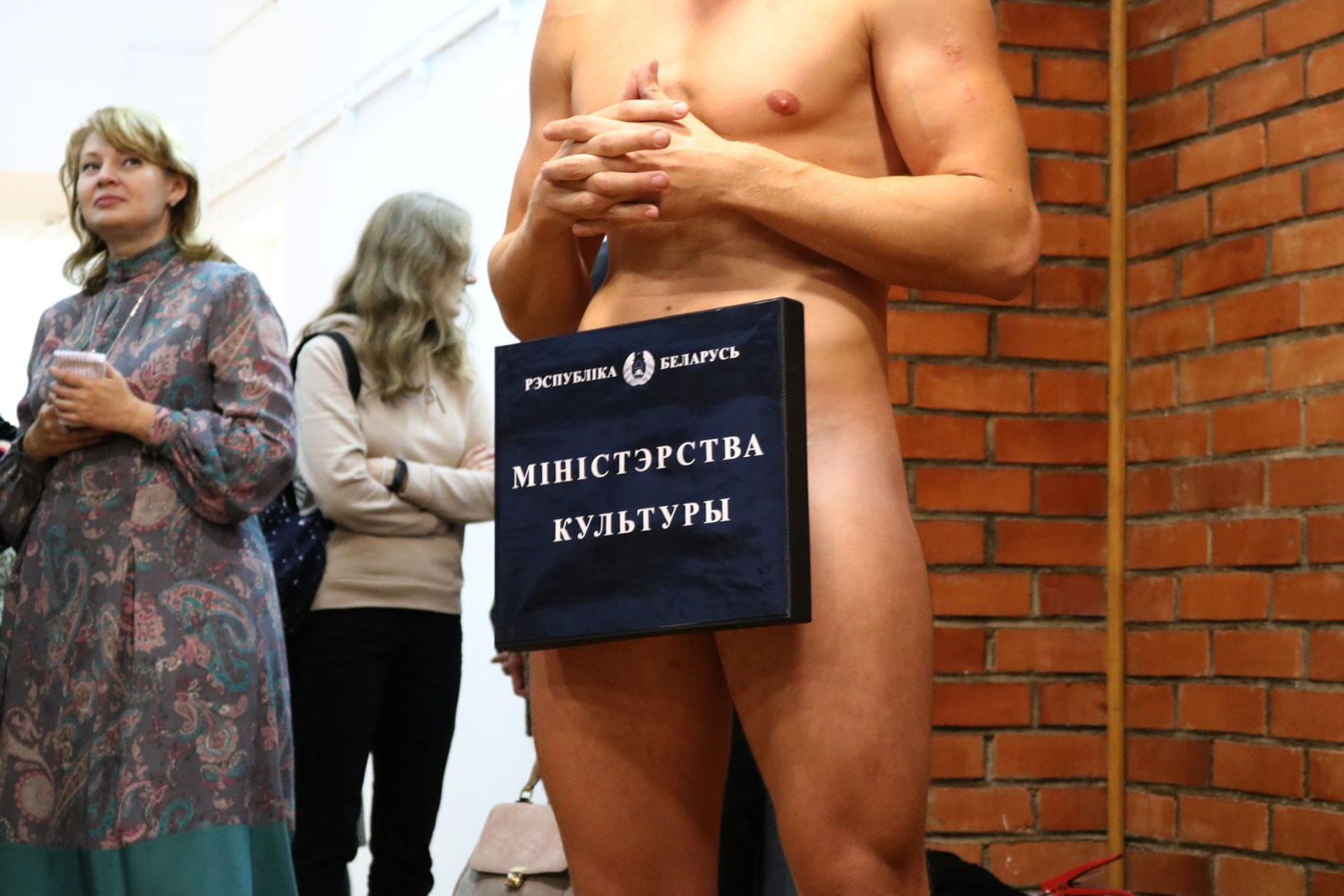
"Shield, or Ministry of Pfaloculture" / 2019, October 3 / Minsk, Belarus
— You speak about “game”. What is “game” for you? Closer to The Glass Bead Game or to Egor Letov’s line “I throw pearls before a herd of swine”?
— I still haven’t read The Glass Bead Game, I keep circling it. And Letov… The SLAG art system is not sitting on top and flicking snobbish pearls at swine. The point of the game is that you can be both in the herd and in the heavens. It’s a constant reverse shuttle from the highest to the lowest, erasing oppositions and clogging them with new ones — your own, favorite.
For me, game is my personal SLAG-system. And ter-art within it is the operating principle, the method by which I crank what I used to call “actions.” The definition “ter-art” fits what I do much better, given what actionism has turned into today with its “actions.” Game is my way of existing. Most constructs presented to us as reality are in fact no different from a virtual game. Someone invented rules, imposed them, secured them; millions believed and live by them, moving along like bots. Sometimes the rules are frankly schizophrenic, insane. But they’re imposed and accepted by the masses — therefore they become reality.
The world is a canvas. Serious mesdames and messieurs play these gigantic games. And the “beads” are the people involved. They bite because of these games, kill, cut pieces off each other — all in the name of someone’s holy games. Always for all the “good” and against the “bad.”
And here an artist is not the one who just called themselves that. The one who managed to impose their own game, their own concept — that’s the artist. Game is a fundamental human concept.
Ter-art — an authorial practice of unsanctioned interventions into social, political, and cultural spaces, staged as “games.” Its aim is to hack the protocols of closed systems through art action, exposing hidden mechanisms of power and taboos, turning reality into a metaphorical field of artistic terror.
The Möbius strip of identity
— In the book you write about being uprooted, about lack of ground. Can emigration be not a loss but a new aesthetics?
— Lack of ground equals loss of identity for many. For me Belarusian identity is the identity of a swamp aborigine, a barbarian, Rousseau’s noble savage. From some mythical, little-known country. Born at transit crossroads, with a heart tuned to defocus, lack of assembly, estrangement, and longing. And I keep this identity. I like being a peat-bog knight. Sometimes I’m horrified by it in myself and run away, pull new identities over me, wallow in them like a dog trying to pack itself in someone else’s smell. But I don’t settle there — no tattooing of that identity; at most I draw it with a marker on my ass.
They say you can’t do without identity. Fine, I’ll swim in the holy pool of identities, jump from one egregore to another, move these masks — but I won’t treat identity like a religion for which you must bite someone else’s throat. Any identity is a candy wrapper.
And emigration? It’s not new fertile soil, it’s concrete. Here no one needs your art for a hundred years. At most — as documentation of post-USSR injuries, a mutated degenerate used to scare liberal children. No one will give you even a scrap of that precious land for your art — only for propaganda. Agree to service ideology, to thank your host — here’s a sign “Art”, an instruction, a muzzle. You’re free in your squeal. Just read the ToR carefully: squeal profitably only toward home. If you don’t fit the ToR — get lost, scumbag, you’re no longer called an artist.
Art in emigration is a grain of sand that sprouts in spite of everything. I want to see myself as a grain growing through concrete. If it gives a sprout in concrete, the form is alive. If not — send it for recycling.
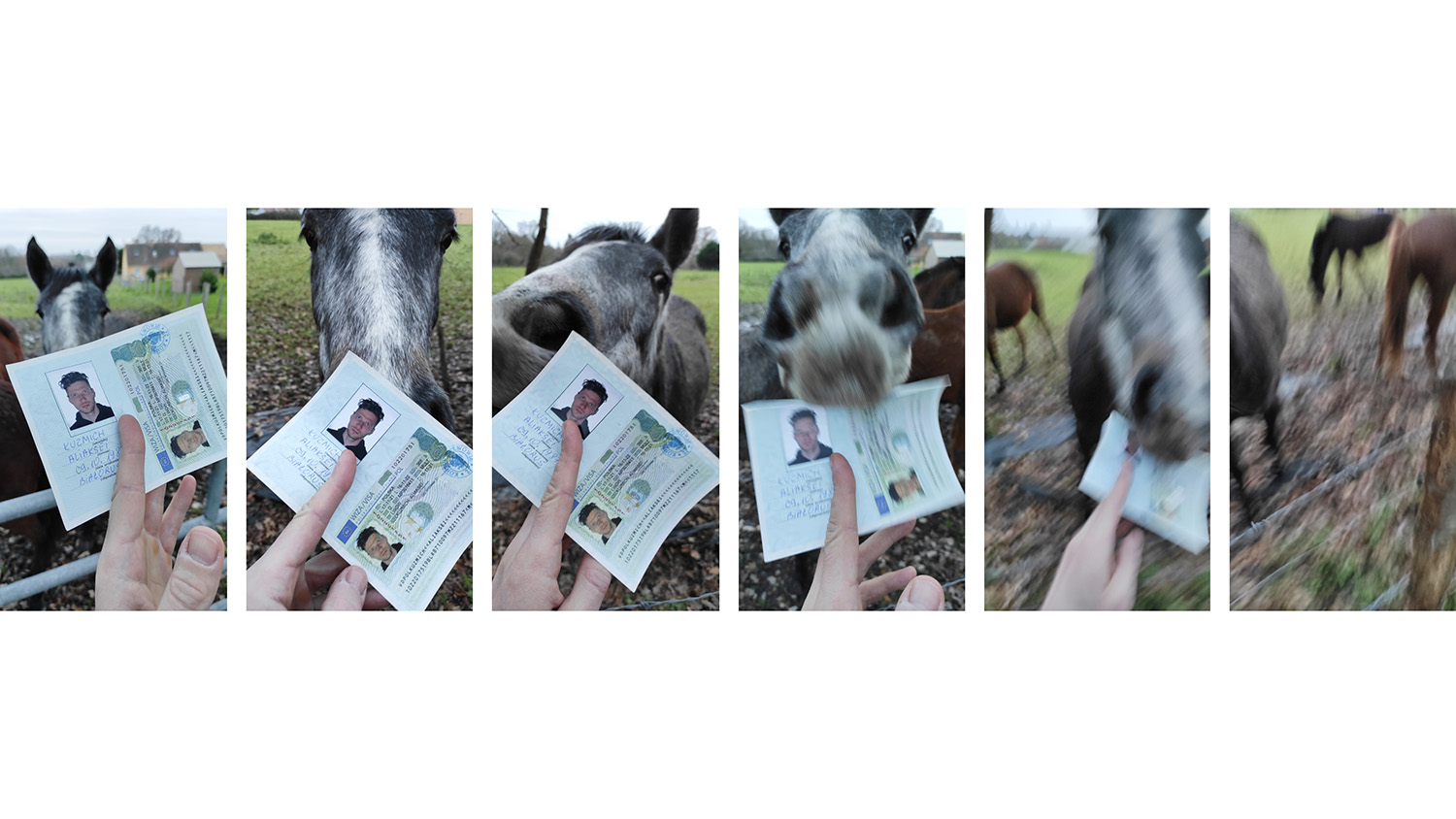
"Feeding the Eurohorse" / 2022.
— In which language — Russian, Belarusian, European — does your art sound more precise?
— First of all, it speaks the language of artistic action. My main language is the language of the body, the language of ter-art, a process that unfolds in space and involves its participants. That’s what the viewer reads at the level of sensations and cultural layers. Words are secondary; language is an addition.
But if we speak about which language is closer to me, it’s Russian. I grew up in a Russian-speaking family and consider myself a Slavic Belarusian. I’m a mix of Belarusian, Russian, Ukrainian, and somewhere Polish lands. My father is a Polesian — almost a separate ethnos.
— If we imagine transit as a circle, what will be your return? Returning to Belarus or going beyond the very idea of the border?
— I’d put it this way: having put a period to the 2020–2023 transit, it turned out I stepped onto the strip of the next transits. In general, transit is one of two main lines running through my entire artistic life-practice.
Transit is a road that helps you generate crystals. When it ends — it will decide itself, not you. And it’s certainly not limited by territories. It’s a process, not geography.
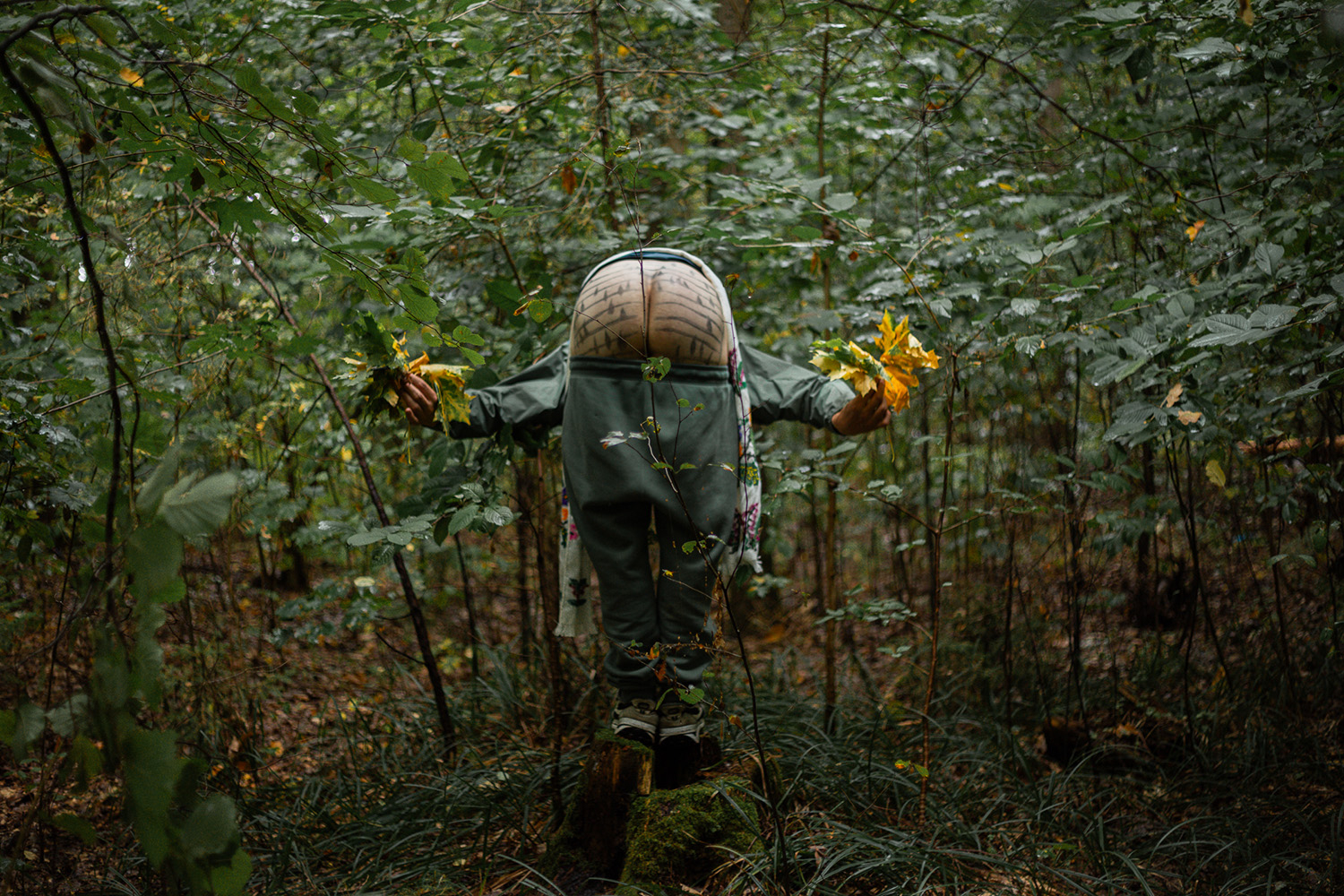
“Transit” / August 9, 2020 – October 9, 2023
— In the book you write about the Möbius strip. Does this mean return is always illusory and transit endless?
— The Möbius strip is the axis I spin on with my art.
When you put a period in transit, you realize the period is the beginning. That it’s a line. Its length is undefined and turns out to be a process. One stage ends, another begins. Like a day immediately replaced by a new one. The end is actually the beginning.
Further — progress is in fact stagnation. AI is not a brain trainer but its dystrophy. Comfort is not happiness. And so on.
Suddenly you track an illusion. Then an illusion within an illusion. And it’s not a mirage or deception invented by someone — it’s how reality functions. You stew in it and suddenly realize you’re on the Möbius strip. You move in a circle, although it seems you go only forward. Everything that was remains; everything that will be repeats. As in Ecclesiastes, presumably written by King Solomon: “There is nothing new under the sun”.
You analyze the history of wars, the history of art, the history of man — and you see cycles, spirals, transits that return to the starting point and then begin new turns. Using the example of my own life and events, I write about this in my second book — the novel Imitation. Maybe it will come out soon. I hope — without censorship.
Möbius strip — a topological surface with only one side and one edge. It is formed by taking a strip of paper, twisting one end 180°, and joining it to the other end. The Möbius strip is used as a symbol of infinity, cyclicity, and the unity of opposites.
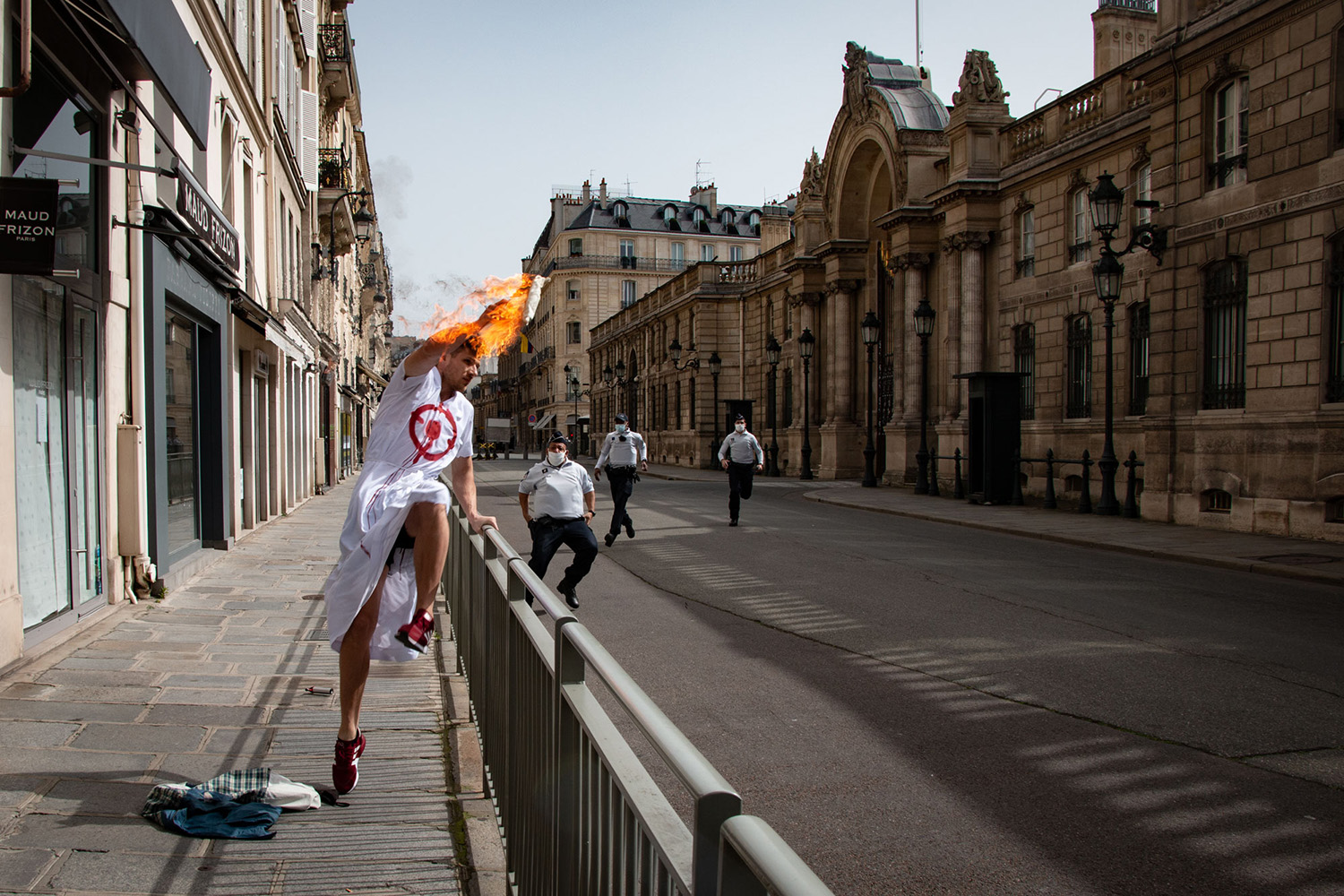
“Imitation” / 2021, April 1 / Paris, France.
— If everything in the world is a game, as you claim, what’s the point of continuing to play?
— It’s like with a failed suicide who realized that everything is finite, all is rot and ahead is nothingness, but instead of offing himself because of this devouring realization, he perked up and exclaimed: “There’s no meaning — okay, I’ll invent it myself!”
The whole world consists of games. Plato, it seems, spoke of people as God’s made-up toys. What else is left but to play? To play for one’s own pleasure.
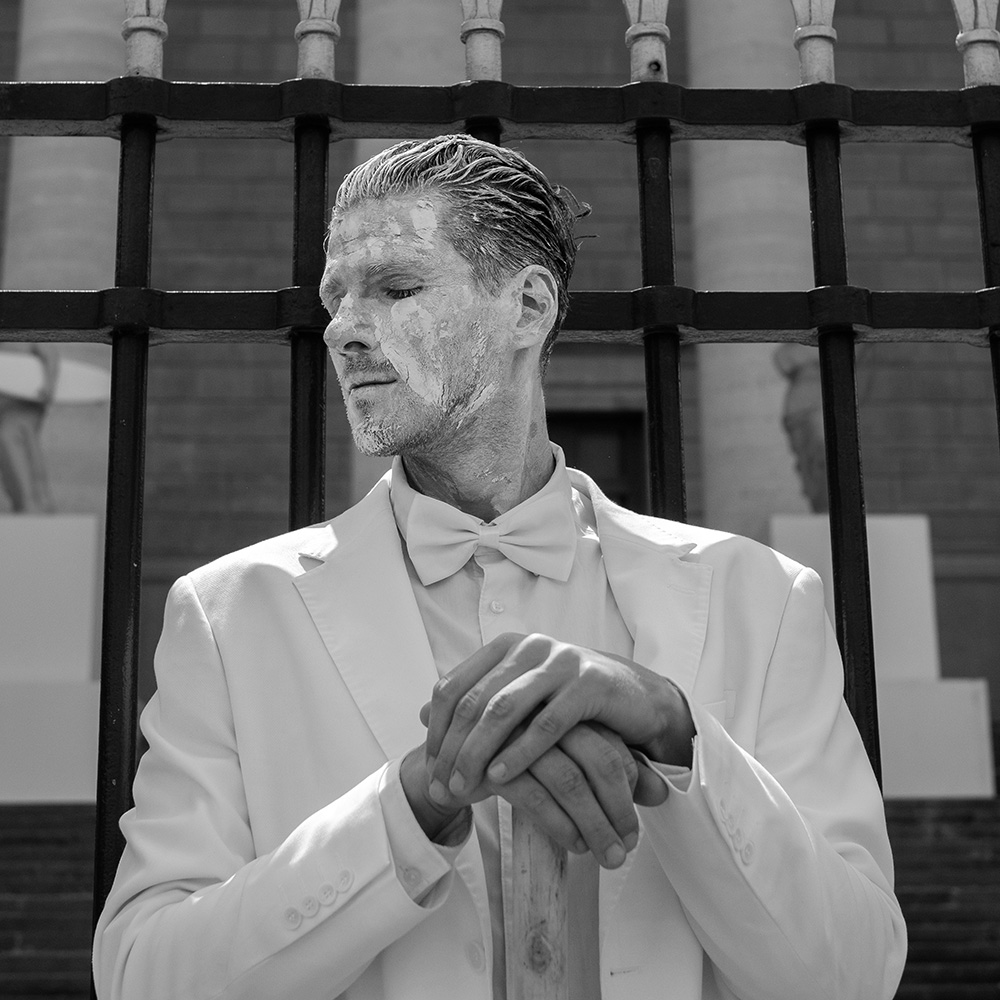
Alexei Kuzmich (junior) is artist and art actionist from Belarus; author of books, texts, lectures, films. Works within his authorial system SLAG art (Self, Live, Action, Game art) — based on turning everyday life and circumstances into a game.
His works exist in the form of artistic action — unsanctioned interventions into public, political, and cultural spaces, which he calls games or ter-arts.
Lives in Paris.
Text author: Henadz Smaliak
Similar Materials


FOLLOW US
INSTAGRAM TELEGRAM TIKTOK FACEBOOK YOUTUBE
© 2026 Chrysalis Mag. All Rights Reserved.
Reprinting of materials or fragments of materials
is allowed only with the written permission